A medieval trading alliance, and the river that paid for it
Nine Dutch towns still present themselves as Hanseatic cities: Doesburg, Zutphen, Deventer, Hattem, Zwolle, Hasselt, Kampen, Elburg and Harderwijk. Most visitors to the Netherlands have never heard of any of them. They sit in a loose line along the river IJssel and the old Zuiderzee coast, east and north-east of the Randstad, and between them they hold some of the best-preserved medieval centres in the country.
What was the Hanseatic League?
An alliance of merchant guilds and market towns around the North Sea and the Baltic, which from the late Middle Ages controlled much of northern European trade. It had no king and no capital. Business was done at assemblies, and member towns sent delegates when it suited them.
The Dutch towns were active in it. Harderwijk, Elburg and Kampen first attended a Hanseatic assembly in 1367, and between then and 1507 delegates from the Zuiderzee and IJssel towns took part in 57 of the 102 assemblies held, according to research published in the Hansische Geschichtsblätter. How many Dutch towns counted as full members depends on the source and the century, which is why the totals you see quoted range from about thirteen to more than twenty.
Why the IJssel
The IJssel is a branch of the Rhine that runs north to what was then the Zuiderzee. That gave the inland towns along it a direct route to the sea and to the Baltic, and Baltic trade is what made them rich. By around 1400, Zwolle, Kampen and Deventer each had roughly ten thousand inhabitants, which in the Netherlands of the time made them substantial cities.
The money went into buildings, and the buildings are still there: merchant houses, warehouses with hoisting beams, big churches, city walls and gates.
The cities along the river
Zwolle is the largest of them and is often called the Hanseatic capital. It is the capital of the province of Overijssel and keeps its star-shaped moat around the old centre.
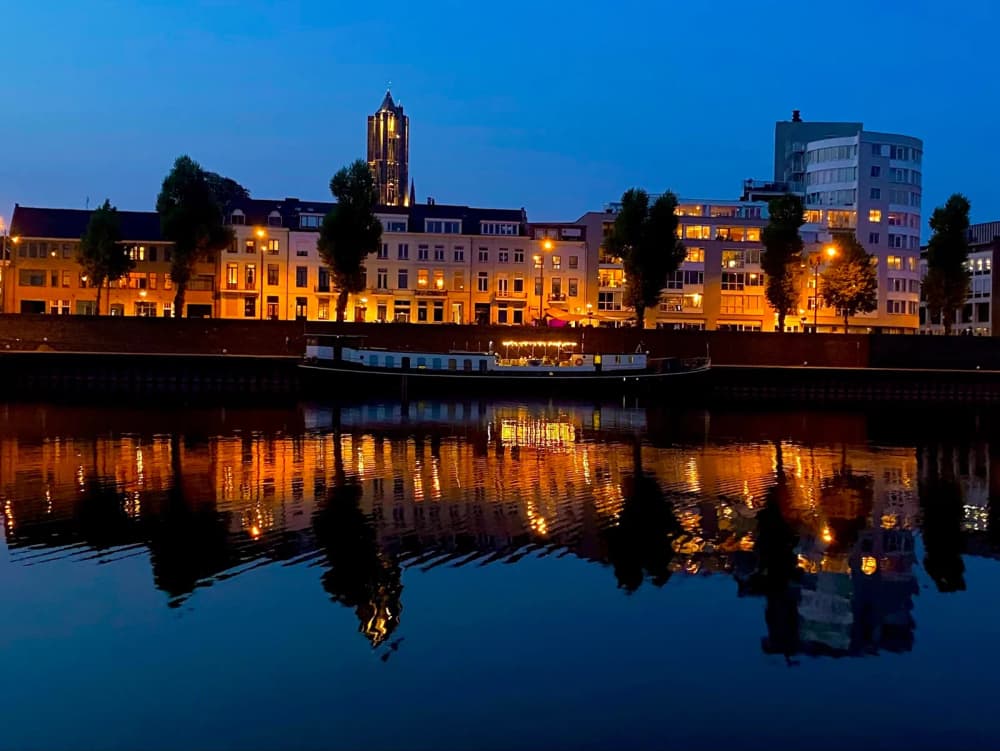
Kampen sits where the IJssel reaches the IJsselmeer. Its waterfront is the classic Hanseatic view in the Netherlands: tall merchant houses and surviving gates facing the river, with a boulevard along the quay.
Deventer lies on the east bank of the IJssel between Zutphen and Zwolle. It is among the oldest towns in the country, traced to a church built by the English missionary Lebuinus in the eighth century, and in the fifteenth century it shared a mint with Zwolle and Kampen.
Zutphen is one of the oldest Hanseatic cities in the Netherlands and has a notably well-preserved medieval centre.
Away from the IJssel itself, Harderwijk keeps its town wall and old fishing harbour on what is now the Veluwemeer, and Elburg is one of the best-preserved fortified towns in the country, laid out on a strict grid inside its walls.
Seeing them from the water
These towns were built facing the water, because the water was the road. Arriving by ship puts you at the front door rather than the back, and the old harbours are usually a short walk from the main square.
Ship Josefien's Hanseatic route is new for 2027 and is the one that covers them. It can be booked two ways, and between the two itineraries it moors in five of the nine Dutch Hanseatic cities.
The 8-day week trip starts and ends in Zwolle and loops via Harderwijk, Muiden, Wijk bij Duurstede, Arnhem and Zutphen, cycling through river floodplains, polders and old dikes while the ship sails ahead.
The 5-day long weekend stays closer to Zwolle and visits Elburg, Kampen and Vollenhove.
One honest note: Deventer is not a mooring on either itinerary, although the route runs up and down the IJssel past it. If Deventer is the one you came for, it is an easy train ride from Zwolle or Zutphen on either side of the trip.
The 2027 dates
The week trip runs from 21 to 28 July 2027 at €1,460 per person. The long weekend runs from 29 July to 2 August 2027 at €890 per person. Both start and end in Zwolle, and both include the bicycle, the cabin and all meals on board.
If the Hanseatic cities are not your week
The same ship runs four other routes: the eleven cities of Friesland on the Elfstedentocht route, the tidal flats and islands of the Wadden Sea, the quiet northern provinces, and the canal cities of Holland on the Rivers & Delta route. All five are compared here.
Ready to Experience This Yourself?
Book your bike & sail holiday aboard Ship Josefien. Limited to 22 guests per voyage.
View Dates & Book Now →Or compare the five bike & boat routes first: Friesland's eleven cities, the Wadden Sea, the northern provinces, the Hanseatic cities and the rivers of Holland.