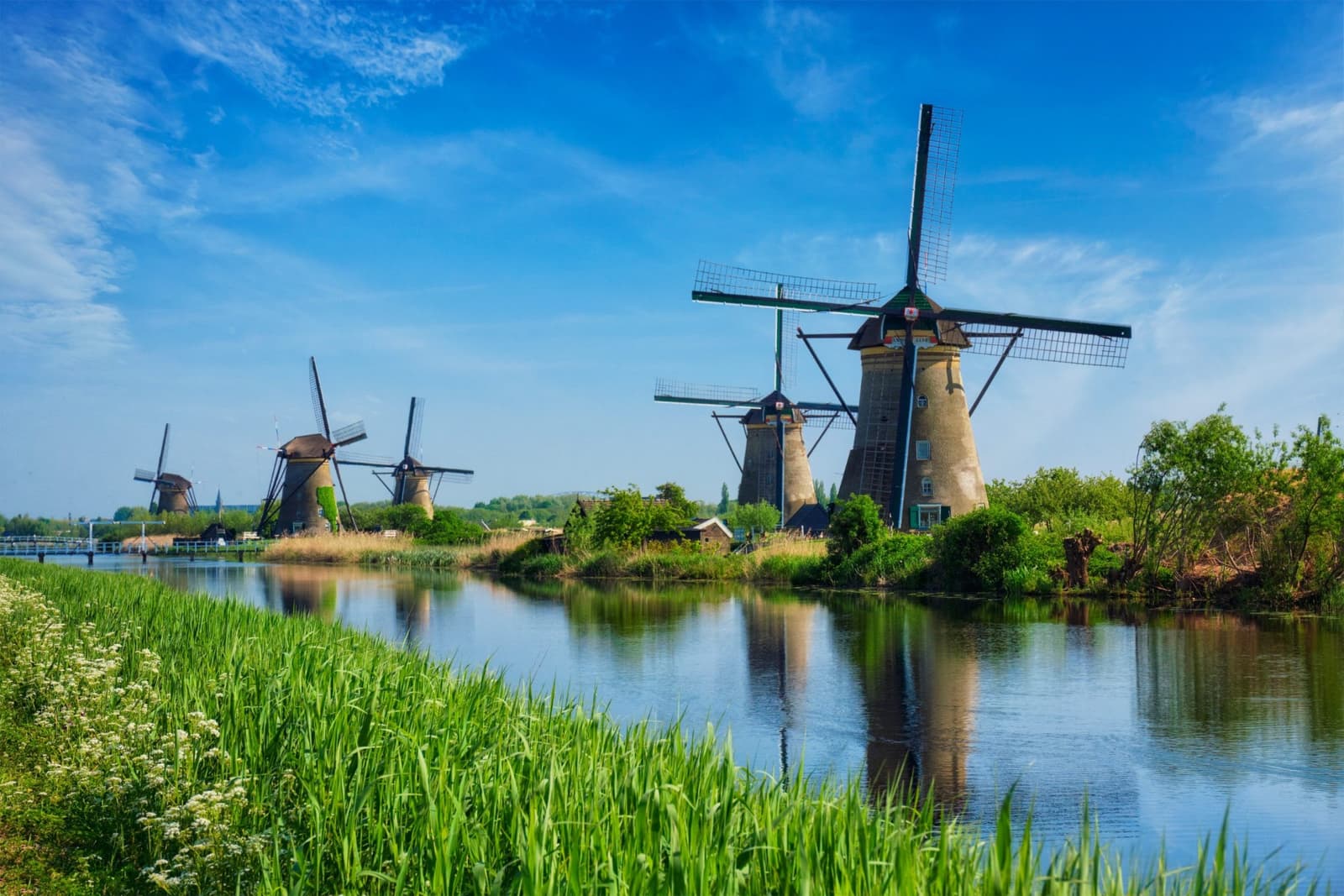
Nineteen windmills, standing in a row
Kinderdijk is a village in the Alblasserwaard polder, where the rivers Lek and Noord meet, in the municipality of Molenlanden. It sits about 15 kilometres east of Rotterdam. What draws people there is a line of nineteen windmills along the water, which is the largest concentration of old mills anywhere in the Netherlands.
It is the picture most people have in their head when they think of Holland, and unlike most such pictures, it is genuinely there.
Why it is World Heritage
The site was inscribed on the UNESCO World Heritage list in 1997 as the Mill Network at Kinderdijk-Elshout. The listing is not only for the mills. It covers a complete, working water-management landscape: the mills themselves, the dikes, the reservoirs, the channels and the pumping stations that replaced the mills later.
That is the real story of the place. The Alblasserwaard lies below the level of the rivers around it. Without continuous pumping, the polder floods. The mills were built in the eighteenth century to lift water out of the polder into a reservoir, from where it could be let out into the river at low tide. The modern pumping stations do the same job today, which is why the landscape still looks the way it does.
Three of the nineteen mills are museum mills that you can go inside, to see how a miller's family actually lived in one.
Getting there from Rotterdam
Kinderdijk is close to a big city and still awkward to reach, which is half the problem with it.
- By water. A waterbus runs from Rotterdam down the Nieuwe Maas and the Noord, and there are services from Dordrecht as well. Timetables and seasonal services change, so check the current schedule before you set out.
- By bike. The ride out from Rotterdam is flat and well signposted, and the last stretch along the dike is the best part of the trip.
- By car. There is parking, and in summer it fills with coaches. The car park is the worst possible first view of the place.
Why the approach matters here
Kinderdijk was laid out to be seen along the water, not across a car park. The mills stand in a line on either side of the channels, so the view changes as you move along them: from one end they overlap into a thicket of sails, and from the dike path they open out one by one.
Arriving by bike or by ship means you come in along that line instead of walking out to it from a coach. It also means you can be there early or late in the day, when the light is low, the reflections are still, and the coaches have not arrived or have already gone.
Kinderdijk on a bike and boat week
On Ship Josefien, Kinderdijk falls on the Rivers & Delta route, an 8-day loop that starts and ends in Rotterdam's Coolhaven. On the sixth day you cycle past the windmills on the way to Dordrecht, a stage of about 30 kilometres.
The rest of that week strings together the classic cities of Holland: Delft, Leiden, Gouda with its cheese market, and the silver town of Schoonhoven. Daily distances are short, between 15 and 40 kilometres, which leaves time to wander through each town before dinner on board.
When you can go
The Rivers & Delta route ran from 1 to 8 June in 2026. Dates for 2027 have not been published yet, so this route is on request: ask Ship Josefien for the next departure.
If you want a confirmed 2027 date, the routes with published departures are the Eleven Cities of Friesland in May, June and July, the Wadden Sea in June, and the Hanseatic route in July and August. All five routes are listed here with their dates and prices.
Ready to Experience This Yourself?
Book your bike & sail holiday aboard Ship Josefien. Limited to 22 guests per voyage.
View Dates & Book Now →Or compare the five bike & boat routes first: Friesland's eleven cities, the Wadden Sea, the northern provinces, the Hanseatic cities and the rivers of Holland.